

Are you considering implementing AI agents in your business but feeling overwhelmed by the potential costs? Understanding AI Agent Development Cost does not have to be complicated or intimidating. By the end of this guide, you will have a clear picture of what factors influence AI agent development costs.
The demand for AI agents is skyrocketing across industries in 2025. Whether you are a small business owner exploring your first AI implementation or an enterprise leader, understanding the true cost of AI Agent Development Cost is crucial for your planning process.
Let us explore this together and demystify AI agent development costs to help you make confident, informed decisions about your AI investment strategy.
Key Takeaways
- Clarity of Objectives: Define your business goals before starting development to ensure measurable ROI.
- Incremental Investment: Begin with a Minimum Viable Product (MVP) to reduce risk and validate business value.
- Hidden Costs Matter: Account for compliance, cloud resources, third-party APIs, and ongoing optimization.
- Total Cost of Ownership: Budget for maintenance, retraining, and scaling, which often equal 15–30% annually.
- Right Partnership: Select a development partner who understands both AI technology and business operations.
- Cost Ranges: Small business AI agents start from $25K, while enterprise-grade solutions can exceed $500K.
- Smart Savings: Use pre-trained models and frameworks to cut development costs by 30–50%.
- Flexible Pricing Models: Choose between hourly, fixed-price, dedicated teams, or SaaS depending on your needs.
Long-term Value: AI agents deliver returns through efficiency, scalability, and improved customer experiences.
What is an AI Agent?
An AI agent is a software entity that can perceive its environment, make decisions, and take actions to achieve specific goals with varying degrees of autonomy.
Think about your business needs for a moment. Do you require systems that can independently handle customer inquiries or analyze data and provide actionable insights? AI agents can perform these tasks with minimal human intervention.
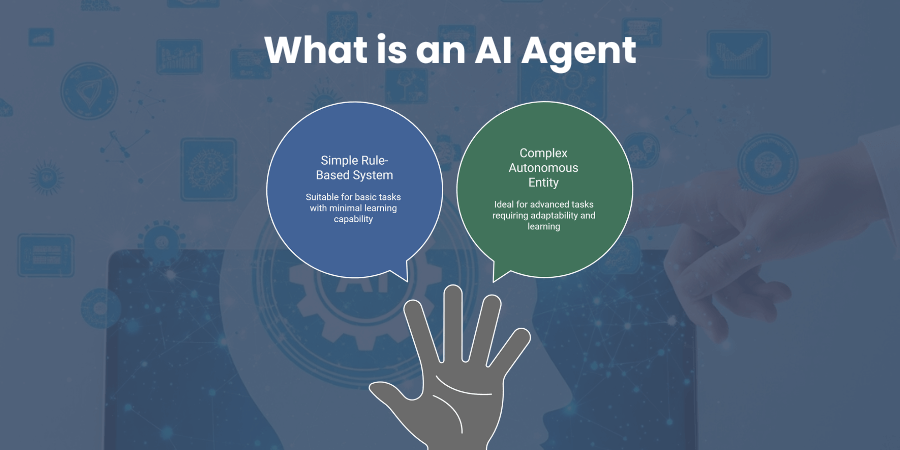
Unlike simple automation tools or basic chatbots, true AI agents can learn from interactions and adapt to new situations. This capability makes them valuable for businesses looking to scale operations without increasing human resources.
The sophistication of AI agents ranges widely—from simple rule-based systems to complex autonomous entities. Your specific business requirements will determine where on this spectrum your ideal AI agent falls.
Understanding what an AI agent is helps you better evaluate the cost factors we will explore next.
Key Factors Influencing AI Agent Development Cost
Are you trying to figure out why AI Agent Development Cost quotes vary so dramatically? Several critical factors influence the cost of building an AI agent tailored to your business needs.
Your specific requirements will significantly impact the final price tag. Let us examine the key factors that will affect your investment:
| Factor | Impact on Cost | What This Means for You |
| AI Model Complexity | High | More sophisticated decision-making capabilities require more extensive development resources |
| Development Team Expertise | Medium to High | Specialized AI talent commands premium rates but delivers higher quality results |
| Integration Requirements | Medium to High | Connecting your AI agent with existing systems adds complexity and cost |
| Industry-Specific Requirements | Variable | Regulated industries like healthcare or finance require additional compliance measures |
| Infrastructure Needs | Medium | Cloud-based vs. on-premises deployment affects both initial and ongoing costs |
| Data Requirements | High | The quality and quantity of training data significantly impacts development time |
When you evaluate potential AI agent development projects, consider how each of these factors applies to your situation. For example, if your business operates in healthcare, you will need to account for compliance costs.
Have you thought about the complexity of the tasks you want your AI agent to perform? The more nuanced the decision-making required, the more expensive the underlying AI models will be.
Tip: Before requesting quotes from developers, create a detailed specification document outlining exactly what you want your AI agent to accomplish.
Breakdown of AI Agent Development Costs
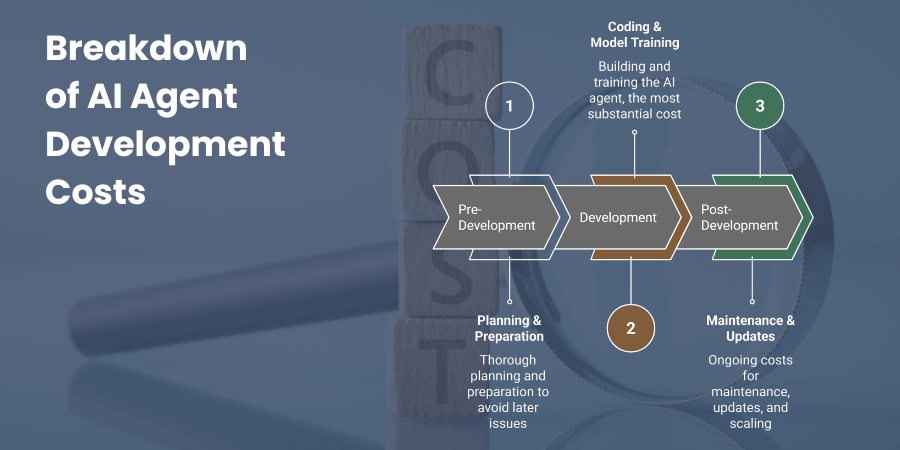
Understanding the cost breakdown across the entire development lifecycle helps you plan your budget more effectively and prevents unexpected expenses.
Pre-Development Costs
Before a single line of code is written, you will need to invest in thorough planning and preparation:
- Business requirements analysis: Defining exactly what you want your AI agent to accomplish
- Market research: Understanding how similar AI solutions function in your industry
- Data collection and preparation: Gathering and organizing the data needed to train your AI agent
- Prototype development: Creating a simplified version to test core concepts
Many businesses underestimate the importance of this phase, but investing adequately here can save you significant costs later.
Development Costs
This is typically the most substantial portion of your investment and includes:
- AI model selection and training: Choosing appropriate algorithms and training them on your data
- Integration development: Building connections between your AI agent and existing systems
- User interface design: Creating intuitive ways for users to interact with your AI agent
- Testing and validation: Ensuring your AI agent performs reliably across various scenarios
The complexity of your AI agent directly impacts these costs. An AI agent that needs to understand natural language requires more sophisticated models than one that simply categorizes data.
Post-Development Costs
Many businesses focus exclusively on the initial development costs but overlook the ongoing expenses:
- Monitoring and maintenance: Ensuring your AI agent continues to function correctly
- Performance optimization: Improving efficiency and effectiveness over time
- Model retraining: Updating your AI agent with new data to maintain accuracy
- Scaling infrastructure: Expanding resources as usage increases
These ongoing costs typically range from 15-30% of your initial development investment annually.
Cost Estimates for AI Agent Development in 2025
Understanding general cost ranges can help you set realistic expectations and plan accordingly.
The following table provides estimated cost ranges based on project complexity and business size:
| Project Scale | Complexity | Features | Estimated Cost Range (USD) |
| Small Business | Basic | Simple decision-making, limited integrations, rule-based responses | $25,000 – $75,000 |
| Mid-Size Business | Moderate | Natural language processing, multiple integrations, basic learning capabilities | $75,000 – $200,000 |
| Enterprise | Advanced | Complex decision-making, extensive integrations, advanced learning, custom algorithms | $200,000 – $500,000+ |
Remember that these figures represent the total project cost, including all phases we discussed earlier.
Many organizations start with a smaller, focused implementation and expand capabilities over time as they realize returns on their initial investment.
For example, you might begin with an AI agent that handles a specific customer service function, then gradually expand its capabilities to cover additional use cases.
Many businesses find that AI agents deliver returns through increased efficiency or improved customer experiences within 12-18 months of deployment.